
Happy fall from DU’s bustling campus where classes have started and a new academic year is in full swing!
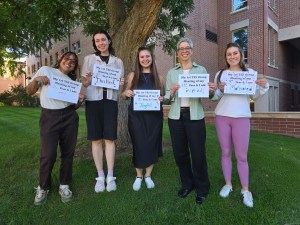
All that activity means that our first Traumatic Stress Studies (TSS) Group team meeting is now in the books. The vibe? Inspired, joyful, thrilled, motivated, and grateful.
The first team meeting also gave us a chance to welcome a new grad student to our team, Ellie McLane.
We asked Ellie a few questions to help you get to know her as well.
Q: Welcome to the TSS Group, Ellie! Tell us about yourself, please!
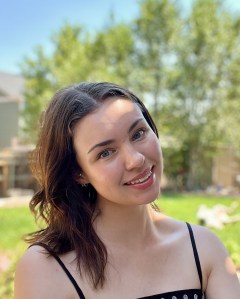
Hello! My name is Ellie McLane (she/her/hers), and though I’m originally from Texas, I consider myself a Coloradan (I’ve been here for 18 years!). I graduated with my BA in Psychology with a minor in Sociology and my MA in Clinical Trauma Psychology from the University of Colorado Colorado Springs. My research background includes time spent in Cognitive Development, Childhood Early Experience, Regulation and Health, and Interpersonal Violence, PTSD, and Substance-use research labs. I also volunteered with a local community nonprofit supporting clinical services and youth advocacy for survivors of intimate partner violence, sexual assault, human trafficking, and stalking. In my free time, you can find me reading, cooking (but not baking), and meandering about with my dog.
Q: As a first-year graduate student in the Clinical Psychology Program, what are your current research interests?
My research interests broadly focus on violence against women and children through community-engaged and mixed methods approaches. Particularly, I am interested in understanding the impact of intimate partner violence and sexual assault on posttraumatic outcomes, parent-child relationships, and risk and resilience. Further, I hope to help streamline access to and efficacy of community support systems.
Q: What drew you to the TSS Group?
When I began my journey in the victim-advocacy realm, I was also establishing myself as a student researcher. Finding that I had a passion for both, I was troubled by the feeling that my community was disconnected from what I was doing in academia. Around this time, I stumbled upon the TSS Group’s and Anne’s work revealing to me that research and community engagement could merge to support survivors. From that moment onward, becoming a community engaged academic researcher became a goal of mine and it is a dream come true to work with the team that first showed me it was possible in the first place.
Q: What do you hope to accomplish as a member of the TSS Group?
I am beyond thrilled to learn from my lab mates, Anne, and the Denver community to further contribute to the field of traumatic stress and support survivors of intimate partner violence and sexual assault. I hope to gain the skills necessary to facilitate community partnerships and advocate for diverse survivors to reach more communities in need.
***

