
Just in time for October’s Domestic Violence Awareness Month (#DVAM), we’re excited to share new research findings with you on:
- Brain injury and intimate partner violence;
- Survivor-centered care; and
- Policy impacts on victim services.
As you’ll see below, TSS Group team members developed posters that give background on the projects as well as describe results and potential implications of findings. Our team members been out on the road to present these posters at two conferences (so far!).
We invite you to view the posters and read a summary of the presentations below. As always, we value your feedback and hope that these findings are relevant to your important work.
Intimate partner violence (IPV) survivors with brain injuries are often overlooked and underserved. As part of a larger study on brain injury in women with police-reported IPV, we interviewed 19 professionals from a coordinated community response team about their experiences addressing brain injuries with survivors of IPV. Specifically, we asked participants to share how and when they bring up brain injury, the language used, and what approaches they find to be effective. Other inquiries included promising practices for screening and serving survivors, barriers related to outreach and the criminal justice system, and ways to improve coordinated responses to IPV. An in-depth synthesis of responses identified key findings across several areas: survivors with brain injuries face unique challenges; practices should be survivor-centered and brain injury-informed; and training, education, and system gaps impact survivors and services. Together, these findings aim to support earlier identification of and response to brain injury as well as the importance of cross-system collaboration and survivor-centered, trauma-informed approaches to brain injuries. Poster presented by Betsy Serrano at the International Society for Traumatic Stress Studies Annual Meeting in San Antonio TX, Fall 2026.
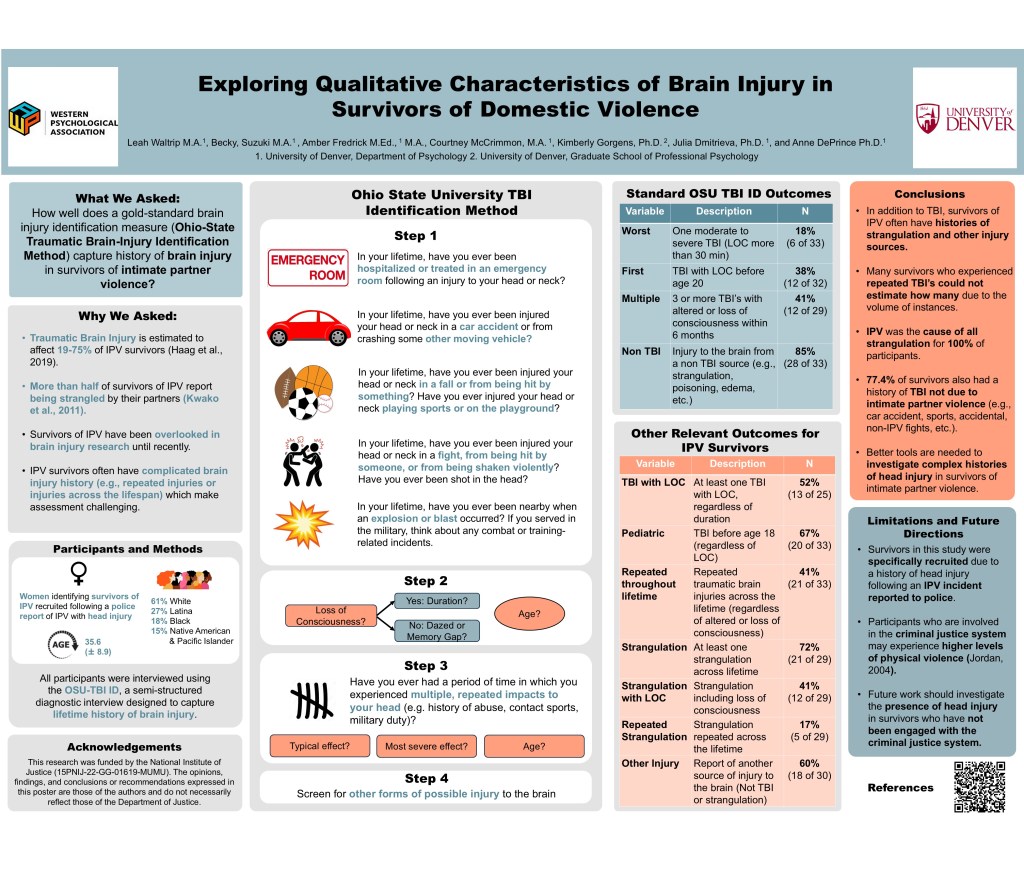
Among women victimized by intimate partners, mild traumatic brain injury is common, affecting an estimated 19-75% of survivors (Haag et al., 2019). Additionally, more than half of intimate partner violence (IPV) survivors report being strangled by their partners, furthering concern for brain injury due to anoxia (Kwako et al., 2011). Until recently, survivors of IPV were largely overlooked in brain injury research. However, emerging evidence suggests that IPV survivors may have complicated histories of brain injury (e.g., repeated injuries; injuries at different points in their lives), which can be difficult to assess. Recognizing potential challenges in measuring brain injury among survivors, we examined the usefulness of a gold standard measure, the Ohio State University Traumatic Brain Injury Identification Method (OSU TBI-ID), with IPV survivors. Women were recruited following injuries to the head or neck in domestic violence incidents that were reported to the Denver Police Department. As part of a broader study, survivors (N=33) were administered the OSU TBI-ID, a semi-structured interview method designed to capture a lifetime history of brain injury. We examined participants’ reports on the OSU TBI-ID to characterize the frequency of mild traumatic brain injury (N=31), strangulation (N=21), and other injuries to the brain (N= 18). In addition, we characterized repeated exposure, loss of consciousness, presence of pediatric injury, and causes of reported injuries (IPV, non-IPV). We identified challenges to scoring and capturing the complexity of injuries within the measure’s coding system. These findings can help inform the best practices for assessing brain injury among IPV survivors. Poster presented by Leah Waltrip at the Western Psychological Association Annual Meeting in Tacoma WA, Spring 2026.
Immigration policy and funding changes can have rapid consequences for survivors and communities. Measuring those changes in real-time can be beneficial in allowing us to see how vulnerable communities are being impacted by systems. Working with community partners, we tested an approach to measuring change using monthly reports from victim service providers about their clients’ legal needs and barriers to getting those needs met. Providers came from victim service agencies across a single state in the Rocky Mountain West and were surveyed monthly about client needs and barriers. Using an interrupted time series approach (Rosenthal & DePrince, 2024), we examined whether monthly perceptions of barriers related to immigration and funding shifted from 2023 to 2025. We found significant increases in barriers related to accessing services due to legal status, deportation fears, and VOCA funding cuts. These trends were reinforced by a separate sample of victim service agencies conducted annually in the same state in fall 2025, which included open-ended questions about the impacts of funding and federal policy changes on clients. Responses revealed descriptions of client fears about accessing legal services and court systems, as well as impacts on immigration-related services for survivors. These findings highlight the importance of partnering with communities to measure the impacts of policy and practice changes. Poster presented by Betsy Serrano at the International Society for Traumatic Stress Studies Annual Meeting in San Antonio TX, Fall 2026.
This presentation described the connections between survivor-centered care and survivor outcomes after engaging in crisis, medical, legal, or mental health services after an unwanted sexual experience. Specifically, higher survivor-centered care was linked to higher empowerment for survivors. Greater empowerment was then linked to lower PTSD symptoms. Survivor centered care was also linked with greater help-seeking, meaning that survivors who report experiencing survivor-centered care were more likely to seek out services in the future, especially when that care was unexpectedly survivor-centered. In contrast, LQBTQIA+ survivors shared they were less likely to seek help in the future, aligning with many qualitative reports that services were not always affirming. Takeaways from this poster include prioritizing survivor autonomy, expanding services to be survivor-specific, and collaborating with survivors is essential to increasing help-seeking and positive mental health outcomes for survivors. You can read more about these findings from a prior blogpost here. Poster presented by Amber Fredrick at the Western Psychological Association Annual Meeting in Tacoma WA, Spring 2026.
***

