by Courtney McCrimmon (5th Year Graduate Student)
January’s National Human Trafficking Prevention Month reminded us of survivors’ resilience and the preventative efforts made to raise awareness and protect vulnerable populations from exploitation.
To continue the fight against human trafficking, we must take collective action to stay well-informed, raise awareness, strengthen protective factors, and take more initiative to support survivors via survivor-informed and survivor-led efforts. While it is not the survivors’ responsibility to move the needle in the fight against trafficking, by centering their lived experiences, we can learn how to best support their restoration, respect their autonomy, and prevent future harm. A step forward in strengthening protective factors is through survivor-centered research.
Prior research has shed light on the lasting consequences (e.g., biopsychosocial, financial) for survivors’ most basic needs. However, less attention has been paid to survivors’ experiences and conceptualization of romantic relationships post-trafficking. The interpersonal abuse dynamics in sex trafficking have relational consequences that pose serious threats to survivors’ relationship health. Women survivors are often victim-blamed as responsible for their victimization. However, traffickers use methods, like romantic relationships and false promises, to force women into exploitation by restricting their freedom and minimizing and neglecting their identities. Rather than framing survivors through a victim-blaming lens, creating a platform for them to share their stories demonstrates that they are the true experts of their survivorhood.
To address this gap, I am excited to use my psychology training as a Black woman to lead a new qualitative study that seeks to understand Black women survivors’ relational experiences after sex trafficking.
This study will be among the first studies to expand the trauma psychology and anti-trafficking fields’ understanding of post-trafficking experiences and survivors’ conceptualization of romantic relationships. Learning from survivors’ perspectives will help promote healthy romantic relationships, inform future services for women navigating life post-trafficking, and support secondary and tertiary prevention efforts.
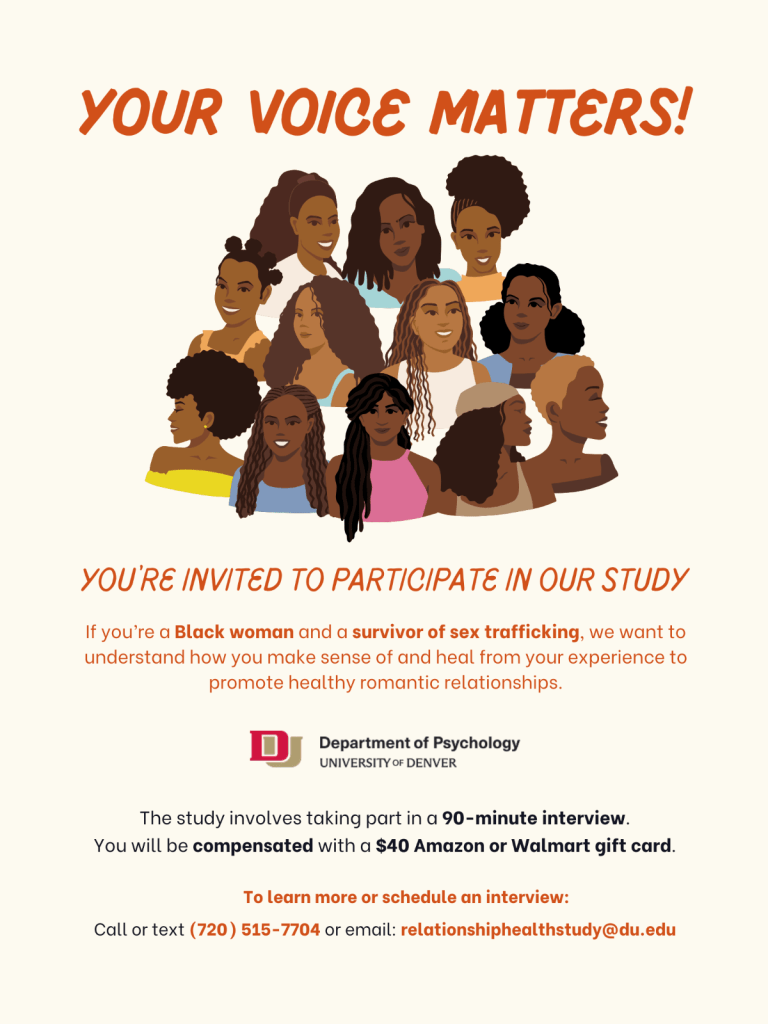
Black/African American women who are 18 years or older and have previously been in the sex trafficking industry (The Life) but have been out of The Life for at least five years are invited to take part in this study. Participation involves a one-time 90-minute interview on Zoom or in-person at DU. Eligible participants will also receive a choice of a $40 Amazon or Walmart gift card. During the interview, participants will be asked questions about their experiences in The Life, their romantic relationship health, and their healing journey since leaving The Life.
Please share the flyer below with anyone who might be interested in the study.
***
 Trauma Research Notes