
by Courtney McCrimmon, 4th Year Graduate Student
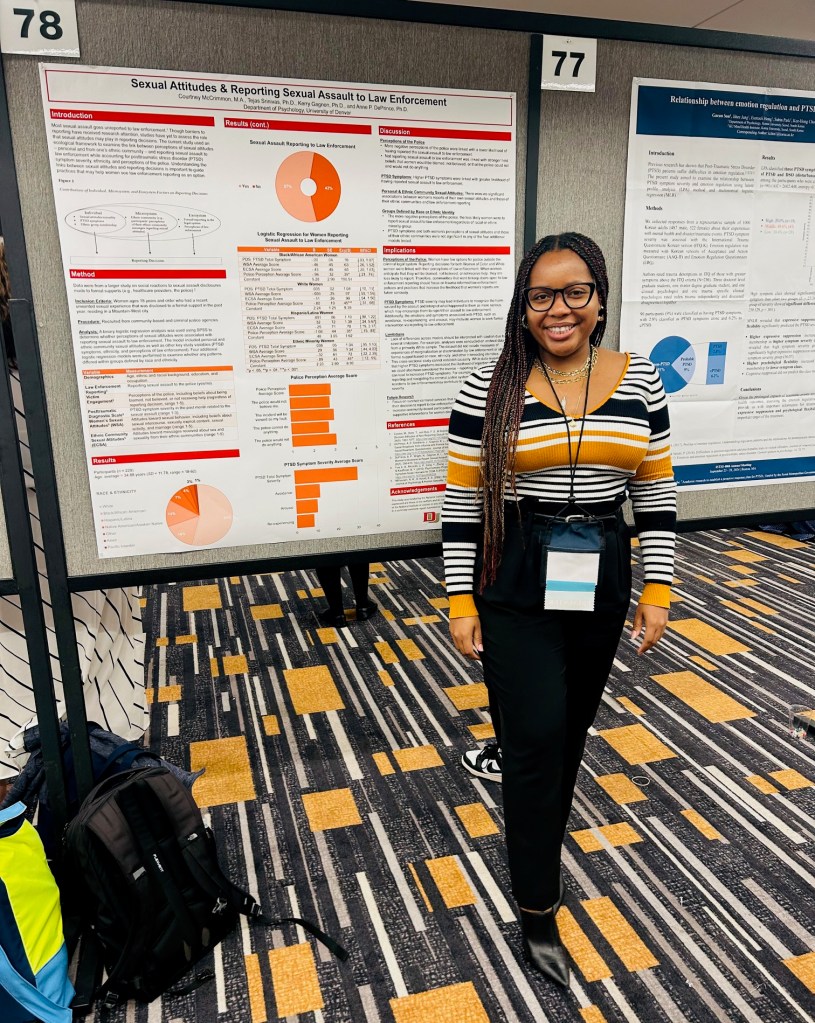
From Bench to Bedside and Beyond: Advancing Translational Science in Traumatic Stress Studies — that was the theme for the 40th Annual International Society for Traumatic Stress Studies (ISTSS) Meeting in Boston, MA this past September. The ISTSS Annual Meeting offers a forum for researchers to share evidence-based studies related to traumatic stress. As a first-time attendee, I presented a research poster on Sexual Attitudes and Reporting Sexual Assault to Law Enforcement. The poster drew on data from our team’s collaboration with Denver’s Sexual Assault Interagency Council (SAIC).
What? What did the poster presentation address?
Using an ecological framework, we examined the links between perceptions of sexual attitudes – personal and from one’s ethnic community – and reporting to law enforcement. Additional factors, including posttraumatic stress disorder (PTSD) symptom severity, ethnicity, and perceptions of the police, were also included in the model. The importance of assessing the link between sexual attitudes and reporting decisions is to guide practices for women so they might see law enforcement reporting as an option.
Analyses revealed that more negative perceptions of the police were linked with being less likely to have reported a recent sexual assault to law enforcement. Notably, this relationship was present regardless of the racial or ethnic minority groups to which women belonged. The results also indicated that higher PTSD symptoms were linked with greater likelihood of reporting sexual assault to law enforcement.
So What? What are the implications of the findings reported?
The bottom line is: When women anticipate that they will be blamed, not believed, or not receive help – as reported by the women in this study – they are less likely to report. Study findings, therefore, point to the importance of trauma-informed and survivor-centered law enforcement practices and policies that increase the likelihood that sexual assault reports are taken seriously.
Now What? What’s next after attending ISTSS? Presenting the poster was truly a meaningful experience. I was surprised by the attention the poster received. I also felt fulfilled because I met other researchers who shared similar interests and saw the need for and value of the research conducted. Those interactions propelled my desire to network with folks whose work aligned with my mission – advancing science through the lens of minority experiences.
In the networking spirit, I attended the student luncheon and connected with like-minded future game-changers in psychology. The experience was a helpful reminder to think about where I’m adding value and with whom, as well as the importance of being a curious learner. What I found most interesting about attending ISTSS was being able to see the work people are doing and identify current research trends — and also to think about what other research areas need to be investigated related to traumatic stress research.
This framework set the pace for approaching the rest of the conference. Whether the session was a flash talk or studies from a special interest group (SIG), I prioritized learning about evidence-based interventions, treatments, and services for minorities. Some of the sessions I attended talked about translating evidence-based PTSD psychotherapy interventions for minority communities, complex trauma, and innovations for reducing racial disparities in trauma treatment. Here are some takeaways that resonated with me the most:
- Across systems, we should think about how to collect demographic information, asking ourselves why certain measures are more relevant than others.
- As researchers, we should focus on sharing findings while examining our priorities. For example, who decides what is prioritized and what is done with the information collected?
- For researches and providers alike, we should think about the overlap of PTSD and racial minority stress disparities and how it can lead to improper treatment. For example, the way minoritized people talk about their problems may not be the same as the way systems conceptualize treatment.
- Providers should develop skills to engage in conversations about race-based trauma. This could mean that additional time is needed to build therapeutic alliance. Providers should directly ask about race-based traumatic experiences and be able to incorporate them directly into treatment.
- Providers should have a current and historical understanding of discrimination and race.
- We should all ask: What if the criminal justice system offered what victims of crime wanted? What would make things right? For example, how could systems focus on apologies, survivor-centered resources, prevention of future harm, and reconciliation.
While the list provided is not exhaustive, attending those sessions reminded me of the importance of cultural humility. As practitioners and researchers, the onus is on us to open the door for people from minoritized backgrounds to share their experiences and a willingness to see the present challenges to make change.
My experience at ISTSS was excellent. I’m more energized. The work people are doing gives me something to look forward to, and I am also interested in seeing where my research takes me!
***
Note: The research described here was funded by the National Institute of Justice (Grant No. 2012-W9-BX-0049). The views expressed are those of the authors and do not necessarily represent the views or the official position of the National Institute of Justice or any other organization. Thank you to participants and study partners, particularly the Denver Sexual Assault Interagency Council (SAIC), who made this research possible.
 Trauma Research Notes