
by Leah Waltrip (2nd Year TSS Group Member, Clinical/DCN Graduate Student)
This past June, I found myself frantically packing an absurdly large, 75-pound suitcase with just about everything you could need for a 6-week trip. I have always gone through life being overprepared. I am the person whose car is stocked with hand lotion and tooth-floss, who has nail clippers and Chapstick in every purse, and who never forgets to bring every sort of medication on an adventure, no matter the length.
But this trip felt different. I was about to hop on a plane to Huanchaco, Peru, where for the next six-weeks I would attempt to learn, teach, conduct therapy, and live my life solely in my second language.
As I unpacked my suitcase in my small-shared room in Peru, I felt a sense of shame at my over preparedness. But this trait, one that has always been with me, was going to become an important lesson I would both cherish and learn to let go of over the next six-weeks.
I am a white cis-gendered, able-bodied woman who speaks English as my first language. I have never been discriminated against because of the color of my skin. I have never known the pain of being mis-gendered. I have never had to evaluate whether restaurants and public spaces can accommodate my needs getting around. And, beyond some embarrassing moments with my host family in Spain, I have rarely been misunderstood because of my inability to communicate in the primary language of a country.
I say this to give context to the amount of privilege I inherently have. As an aspiring bilingual mental health professional, this privilege is wildly important to acknowledge outright. And I am incredibly grateful for my experience with the PASEO Linguistic and Cultural Development Program.
This 6-week cultural immersion program humbled me. As I fumbled my way through lesson plans in front of 120 students a day, mis-gendered words I had had memorized since 6th grade, and embarrassed myself with my grammatical errors, I realized I was actively learning the greatest lesson I needed to work with future Spanish-speaking clients: how drastically things change when you need to express yourself in a second language.
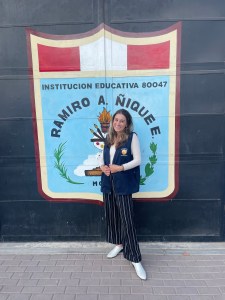
Reflecting on my experience in Huanchaco, I brought home some to offer some practical advice for non-native Spanish speakers advice from my classrooms, therapy sessions, and daily interactions:
- Address the Elephant in the Room: You should openly and directly acknowledge your level of Spanish, admitting where you will make mistakes. If you, like me, have privileges that are openly visible (white, cis-gendered, etc.), state them openly and let your client know you aren’t trying to skirt around this topic.
- Ask for Feedback: Directly ask for feedback from your client. After acknowledging that you will make mistakes (and giving examples of where you struggle most), invite them to correct you, assuring them that you appreciate and desire this feedback. Within the mental-health field, we often talk about therapy being a collaborative relationship. Inviting this opportunity for teaching/learning within your interactions helps to level any hierarchical dynamics at play based on identity/position/etc.
- There are some things you just can’t prepare for: Flexibility in your work with Spanish-speaking clients is vital. You might find yourself wanting to script out every experience – but this is impractical and unfeasible. While I found myself wanting to script out every lesson plan on violence prevention, I quickly saw how that would distract me from engaging with my students in the moment. The same happened in therapy, where I would draft 5 relaxation techniques for my session, only to realize a client wanted to work on something different entirely. Trust your ability to go with the flow – small grammatical errors and those “como se dice” moments don’t distract nearly as much from your ability to communicate as you think they do. Allow yourself to go off script and take note of how your client responds.
- Don’t underestimate the power of formality: I have noticed that many of my friends and colleagues who have learned Spanish as a second language tend to default to using either “Tu” or “Usted” exclusively when trying to address someone directly. However, when and how we use these different conjugations conveys a lot of meaning to Spanish-speakers. When speaking to children, using “usted” is inappropriate and awkwardly formal – you should always default to using the “tu” form when talking to children. If speaking to adults, using “usted” conveys a sense of respect that should always be the default when meeting someone for the first time. If you have been working with a client for a long time and you feel uncertain about whether to use “tu” or “usted” with them moving forward, simply ask! It is polite and gives them the option to decide.
- If you feel in over your head, you might be right: Being bilingual in a professional setting is significantly more difficult than using Spanish to get around a foreign country when you are visiting. If you are feeling overwhelmed and unsure, you can always seek out training programs, supervision with a Spanish-speaking supervisor, or take an evaluation to see if you need further training. The ACTFL OPIC evaluation is a good baseline evaluation which will give you better insight on your skill level (For those who do clinical work, Advanced Low is the lowest score needed for Clinical Proficiency).
- Growth is humbling: Don’t be discouraged by days where you feel unable to communicate effectively. If you have sought out adequate supervision and training, it is going to feel worse before it gets better. And that space in between is the sweet spot where you can develop an understanding of how hard it is to communicate in another language. This understanding might just be the most vital thing you take away from this journey after all.
More information about the PASEO Linguistic and Cultural Development Program can be found here: PASEO Program. A huge thank you to Dr. Brie Kohrt, Dr. David Martinez, and Lourdes Cabel Salinas, along with all of my cohort mates, who made this life-changing experience possible.
***
 Trauma Research Notes